Showing posts with label ornamental. Show all posts

Wednesday, March 9, 2016

A Silk Painting about a very special Place - Machu Picchu in Peru

As the next post will be about Peruvian textile art I am re-writing this post from a long time ago. Machu Picchu has always been a mysterious and magical place for me and I cannot get enough from listening and watching all sorts of documentations regarding this sacred place. To visit this spot in reality must be an incredible experience where already due to lack of oxygen the sucseptibility to spiritualism probably grows noticably. How could this place leave anyone untouched?

The silk painting Machu Picchu belongs to the Magic Symbols Series. I love the warm colours and the golden ornaments leave a feeling of preciousness. Even if you choose an art print instead of the original it will leave the same feeling as I use to add gold pigments by hand after the printing process to all prints where the original has been painted accordingly with gold metallic pigments.

Machu Picchu is truly a magical place, an archeological site which still holds many secrets. Thousands of tourists undertake each year an incredibly exhausting trip to this place which is not easy to reach as it is hidden high in the mountains of the Andes. 

"Most archaeologists believe that Machu Picchu was built as an estate for the Inca emperor Pachacuti (1438–1472). Often referred to as "The Lost City of the Incas", it is perhaps the most familiar icon of the Inca World.
The Incas started building the estate around AD 1400 but it was abandoned as an official site for the Inca rulers a century later at the time of the Spanish conquest of the Inca Empire. Although known locally, it was unknown to the outside world before being brought to international attention in 1911 by the American historian Hiram Bingham. Since then, Machu Picchu has become an important tourist attraction.
Machu Picchu was declared a Peruvian Historical Sanctuary in 1981 and a UNESCO World Heritage Site in 1983. Since it was not plundered by the Spanish when they conquered the Incas, it is especially important as a cultural site and is considered a sacred place." (from wikipedia)"
Whatever might turn out to be the real purpose of Machu Picchu - there is no doubt that this is a place full of magic and an incredible aura. Until today artefacts are found at this site and may lead to new discoveries.


"Machu Picchu"
40" x 13" 
silk, stitched

The ancient golden ornaments certainly add a special touch to the historical city and dreams about the lost treasures of the Inca people...


 ~~~


Sunday, February 21, 2016

Wrought Iron - The Art of Handcraft

As promised I am reviving this blog with a post about one of my favourite design themes: wrought iron.

This is the second post about wrought iron - last time the theme was wrought iron beds and other furniture. This time I am talking about the "art of handcraft", which seems to be an oxymoron because either is commonly used separately but in my opinion wrought iron can be a wonderful example for the perfect marriage of both terms. I am convinced that you will find the following objects as charming as I did.

Wrought iron has been used for centuries - the Eiffel tower being one of the most famous exponents - for many different purposes such as handrails, gates, fencing, all kinds of ornamental objects etc. Today most items are produced from mild steel but are still declared as wrought iron although not manufactured by hand any more. I don't want to linger on this fact but simply show an array of beautiful examples which can enhance a home in a very sophisticated way.

Venice – Ornamental barred window
image source

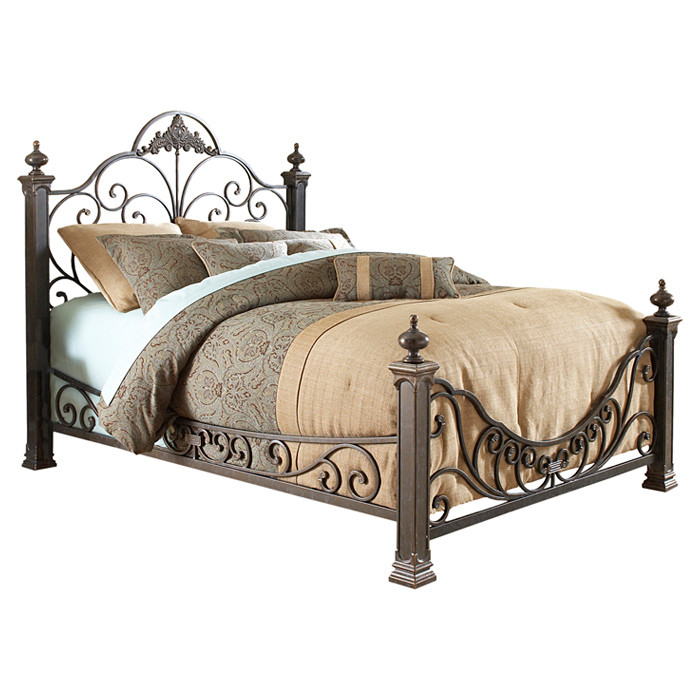
The following is an incredibly beautiful example for a wrought iron bed which I love especially:

image source


image source

Another application for wrought iron would certainly be chandeliers and lanterns/sconces as below. Nothing could evoke a more romantic feeling than lighting made by these beautiful pieces:

image source

image source

The next examples show the possibilities how wrought iron can be a magnificent interior design element for a private home and public rooms: 


And although the following examples are the classical application for exterior design, namely fences, doors and gates, I did not want to omit them because they are so beautiful exponents of this handcraft:


image source

image source

 image source

image source

image source

image source 

image source

And another classical application for wrought iron would be the railings for staircases and balconies of course:


image source

Last but not least wrought iron is an impressive "material" for sculptures of course:


image source

image source

image source


~~~


Saturday, September 22, 2012

Too much Contrast

Although I like clear lines and a minimalistic decoration in a room depending where it is and what the surroundings are, I find this one to contain too much contrast. In tropical landscapes you have plenty of light and the abundance of vegetation often needs a counterpart of simplicity. In this case though the contrast is too harsh in my opinion and the placement of the two additional colour spots increases the contrast even


This could easily be softened by different artwork above the bed such as this wall hanging and the silkcarving on the opposite wall.


The wall hanging above the bed is an art quilt made entirely of silk and handquilted with silk. The small wall hanging on the opposite wall is a silk carving, also made of silk and hand stitched with silk. Both have been painted with silk dyes and metallic pigments.


"Apsaras"
52" x 69", silk art quilt
©Petra Voegtle

You can read more about this art quilt here. There are also more detail photos to see.

 
"Apsara"
( from the Angkor's Faces series)
silk carving, 14" x 14"
©Petra Voegtle

The above silk carving has been mounted on stretcher bars and is ready to be hung with or without additional frame.

~~~

Monday, August 27, 2012

Buddha and Krishna in a Hallway

This is an image I saved a long time ago. A wonderful spacy hallway of a huge villa or even hotel somewhere in Asia. During my travels I have seen the most beautiful and spaciest lobbies in Southeast Asia where they seem to have plenty of place although this is paradoxical in overcrowed cities such as Hongkong or other Asian metropoles. But somehow there is always money somewhere which can buy these places with spaces that cover a whole village...


There is a beautiful Buddha statue in the background and I thought I have created another beautiful sculpture that could serve as a wonderful room devider: a triptych of "Krishna and Radha" without obscuring the view towards the Buddha but what an impact this could make:


This paravent has been entirely handcarved from pinewood and then painted with a varnish that looks like old ivory. It took me 9 months to finish this work from drawing to polishing and quite some blood as a sacrifice. The chisels are very sharp! It was inspired by Indian stone sculptures and wood carving but the design is truly original.
I have added a few detail photos for you so that you can see how filigree the carving is.


"Krishna and Radha"
Indian style triptych, hand carved, massive wood, 
85" x 93" x 7", 65 kg
©Petra Voegtle


~~~


Saturday, March 3, 2012

FINDS: Exotic Gourd Lamps by Calabarte

I think it is time to show you another of my FINDS on the internet. You may have seen this already but I am sure you will be enchanted and seduced by these the same way as I was when I saw these images for the first time.

I was immediately struck by the magic of the shadow patterns these lamps create on a wall as I am also a big fan of all Moroccan handcrafts, especially the ancient brass lamps which also live through the pattern they create on ceilings, walls and floors.

"Artist Przemek Krawczynski from Poland can turn an ordinary gourd into a wonderful, stunningly beautiful table or wall lamp. There aren’t any analogues and never will, because all this is manual and very tedious work. Przemek dries gourds and then lignified gourds decorates with various ornaments. Przhemek’s works are known under the brand Calabarte. Carved patterns, ornaments, holes and figured the track, colored rhinestones add to pumpkin-chandelier an elegant and exotic look. Light from such exotic lamps will surely give any room an extra special atmosphere." (read more...)

But the gourd lamps of the artist do not only live through the light and shadows they are also very fine pieces of art, intricately carved from Senegalese gourds.

In his own words Przemek says: "The pattern of the lamp is structure of symetric, crossing branching as from the perforated layer through three basic outer forms to the deeper light carvings.
White surfaces are deeper layer of wood which allow some light to pass through it. Although the thickness of gourd mostly don’t exceed 4mm (more is on the top and bottom) the carved patterns in that places create structure of three different depth. Each one shines with different intensity. That carvings were definitely the most demanding part of work. The supporting stem is finished with brown jeweller waxed cording.
Also the part of the cord between base and switcher is weaved by thin cording in the same type.
The base is carved in wood and finished with natural italian oil."

Enough said - here are some images which show wonderfully how the lamps look like in natural daylight and how they magically transform everything that's hit by the lightbeams in the dark:


(all images with courtsey of the artist)


If you are eager to see even more of these beautiful images please check Przemek's Facebook page.


~~~

Related Posts Plugin for WordPress, Blogger...