We had a look into the
Bedrooms of the Royals and we saw some examples of
Ancient Beds and Bedrooms. Most of them were everything else than comfortable and cosy like today's. Hygiene was not known, simple people slept with their animals in the same room sometimes, caves served as bedrooms which can be seen practically allover the world. Mesa Verde in Northern America being one of the most famous certainly.
Now I have another intriguing subject regarding bedrooms: how medieval - renaissance bedrooms experienced a kind of revival in the Goth Scene. I have to admit that I am in no way linked to the Goth Scene and therefore you must forgive me if I get certain things wrong or misinterpret others. Please correct me if there are any errors. I am just fascinated by the opulence of medieval decoration and interior, the materials that are used, the deep colours not to speak of the elegance and the love for detail. Additionally I admire the sophisticated craftmanship that is involved in these interiors, in the furniture, in the textiles.
I do not want to analyze any sociopolitical dependencies and interferences between the various subcultures - I only want to point to some of the commonly known attributes that are accredited to the Goth subculture in the 80's, such as the dark decoration and interior design of certain rooms which are used as a refuge. Mostly walls and ceilings were kept in black/dark colours and decorated with heavy dark textiles. Accessories such as crosses, dried flowers, heavy chandeliers and candleholders, skulls and horns of dead animals were meant to create the appropriate ambience. It is the elaboration and exclusiveness of the materials that were often used and that fascinate me most: heavy brocades, silks and embroidered velvets in colours such as deep purple, dark reds, black and dark greens adorned with silver and golden threads. Personally I would refuse though to use anything that was part of a living animal slaughtered to be used for human amusement. There are other ways of presenting the animal in dark images.
In the late 90's though this kind of decoration was replaced by a more commercial version and changed into a style reminiscent of the Victorian era, accompanied by the art of the Pre-Raphaelite movement. This is probably the reason why the market for heavy medieval or Renaissance style furniture has never died.
It is amazing how large the market actually still is for medieval furniture as replica as well as for originals. Only during my research on the Internet I realized that there is a large interest for extremely heavy bedroom interior and I wonder why. Maybe people are just fed up with all the modern stuff that often lacks imagination, passion and a whiff of mystery? Medieval decoration is undoubtedly impressive but certainly does not fit everywhere. You need large rooms for heavy furniture. You definitely make a strong statement with an interior such as shown in the following images:
image source
image source
This is a more moderated way of decorating a Goth bedroom which I find quite intriguing:
image source
Another possibility is to simply use "Gothic" shading for your bedroom, moderate but still giving your room the very special aura of mystery which I could live with:
image source
Back to the heavy medieval furniture for a bedroom. On my way I found this quite impressive four poster bed that looks like a little chapel. The manufacturer says that the design was inspired from an old Gothic castle king's bed:
image source
As a "creator of ambience" and stage designer Renzo Mongiardino definitely fulfilled all phantasies of a theatrical sense. One of his creations would certainly make any Goth's heart "burst" into excitement:
image source
Another American icon designer with a sense for theatrics and drama was Tony Duquette. His house "Dawnridge" in Beverly Hills is full of examples which could fulfil any expectation for the unusual, theatrical design worth a king living within its walls:
image source
Let's visit the places where people actually still live with the medieval traditions at least design wise. And where would you find more places with Gothic traditions than in England and Scotland? F.e. Edinburgh castle and its neighbourhood can offer you what you might have dreamt of: sleeping in a Gothic bedroom. This would certainly be completely different from any hotel room you might have ever spent the night, adding even a tiny bit of a creepy feeling from a place where hundreds of so-called witches have been murdered:
"...the Witchery was established by James Thomson OBE, in a historic
building at the gates of Edinburgh Castle. At the historic heart of
Edinburgh's Old Town, the Witchery takes its name from the hundreds of
women burned at the stake at the stake as witches on Castlehill during
the sixteenth and seventeenth centuries. It is reputed that more
witches were put to death on Castlehill during the reign of James VI
than anywhere else in Scotland. The area around the Witchery by the
Castle remains deep in history." (read more)
image source for the above 3 images
You could also pay a visit to Llanthony Secunda Manor, 40 min. away from Cardiff in Wales. How would you feel to sleep in a bedroom such as this one:
image source
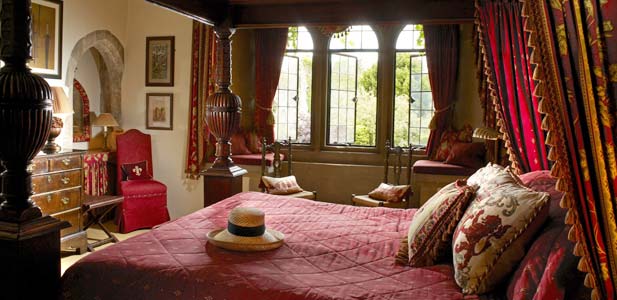
More opportunities to have a medieval hotel stay you will find in Amberly Castle in Sussex. Look at this wonderful bedroom:
image source
Many grand places in Europe which were blessed with medieval interior that has not been destroyed nor displaced by the various wars have been turned into museums due to the immense costs for renovation and maintenance. Here is an example of an early Renaissance palace in Florence - the Palazzo Davanzati. It is quite interesting to read about the history and welfare of this palace which is symptomatic for many places such as this one:
image source
To fulfil your own dreams of a Renaissance or medieval revival in your home you might find the following inspirational.
Look at this fabulous Italian Renaissance bed that I found through Inessa Stewart's blog. Wouldn't this be the jewel of any Goth inspired bedroom?
image source
Here is another historical Renaissance bed that was used by Heni II, displayed in Chenonceau Castle (France.
image source
And if you still haven't had enough of medieval bedrooms you could read this interesting article about
Beds through the Ages and how people lived/slept in the past.
Another interesting article about the various bedroom interior styles of the English Renaissance period and a short historical background can be found
here. But this is by far not everything you can find. For now I leave it to your own discovery...
~~~~