Showing posts with label textile art. Show all posts

Saturday, March 12, 2016

Peruvian Textile Art

A little while ago I read a wonderful travel report from Diane Dorrans Saeks in her blog The Style Saloniste about Peru. And that reminded me of the wonderful textile art you can find in the Andes countries.

Especially the weavers of today can look onto an ancient tradition, dating back up to 4000 years. The oldest textiles were found at the pre-Columbian temple of Huaca Prieta in the Chicama Valley. The materials used then were brown and white cotton, vicuña, alpaca and llama wool. Sometimes materials such as human hair and bat fibers were included, more often gold and silver thread. Main weaving locations are Cuzco, Lima, Ayacucho, Puno, Junin and Apurimac. The colourful decorative works of today are often dyed with industrial dyes although natural dyes are still used as well or rather again by artists.

  image source

On the website of a shamanic center I found the following two examples of peruvian textile art. Unfortunately I could not find any information about these pieces but I love the patterns as well as the colours...


image source

I am sure when people mention ancient Peruvian art they think of those incredible gold treasures first place which have been found in a country that can be proud of so many cultures and incredible works of art and craft. These treasures have made the country extremely vulnerable against looters and thieves and only since a few years "Peru has moved aggressively in recent years to reclaim works of its early cultures that have ended up abroad not to mention "private collections" where the artefacts unfortunately will be lost to the public and scientific research. In November last year, a final batch of thousands of artifacts from the ancient Inca citadel of Machu Picchu were returned to Peru from Yale University." (read more)


image source


Between 600 and 1000, long before the Inca, the Wari (Huari) founded a society widely regarded today as ancient Peru's first empire. Wari became dominant in much of the territory of the earlier Moche and later Chimu cultures. Their textile art is beautiful.

image source
 
image source

One of the most extraordinary masterpieces of the pre-Columbian Americas is a nearly 2,000-year-old cloth from the South Coast of Peru.
Despite the textile's small size (it measures about two by five feet), it contains a vast amount of information about the people who lived in ancient Peru; and despite its great age and delicacy, its colors are brilliant, and tiny details amazingly intact. (after The Paracas Textile).

The following images are from the website of the Khanacademy and show incredible workmanship that rather seems to belong into "modern times" rather than from 2000 years ago...


image source

On the above website you can find a fascinating explanation how this mantle has been created. There is a very special technique involved how the figures of the border have been created - crossed-looping. A diagram shows how this has been accomplished. The result looks nearly like knitting. Imagine that this example (The Paracas Textile) of unbelievable textile art is about 2000 years old.

Another breathtaking example from the Paracas culture is this mantle (normally used for wrapping up mummies in bundles):

image source from Wikipedia


But the first reason for all these introductions into Peruvian Textile art and its thousands of years old tradition is a modern fiber artist - Maximo Laura. His award winning wall hangings are breathtakingly beautiful, full of mysteries and I am sure you will feel the same excitement and enthusiasm when you see his work if you don't know him already. He is an incredibly diligent artist and his works have been shown all-over the world. I can only show very few examples of his wonderful art:


Aire Vital, 20 x 20 cm. Alpaca, cotton, mixed fibers. Peruvian Contemporary Tapestry Art
image source

 Augur of the Harvest Time, 82 x 140 in, Alpaca Wool, Mixed Fibers. 
Handwoven Peruvian Tapestry Art


 Camino Ardiente Hacia la Luz, 47 x 95 in., Alpaca Wool, Mixed Fibers. 
Handwoven Peruvian Tapestry Art
image source

Looking at the Balance of Life, 68 x 124 in., Alpaca Wool, Mixed Fibers. 
Handwoven Peruvian Tapestry Art
image source


 Ritual of the Birth Song, 96 x 48 in, Alpaca Wool, Mixed Fibers. 
Handwoven Peruvian Tapestry Art
image source


The Dream of the Warrior of Light at Dawn, 99 x 48 in, Alpaca Wool, Mixed Fibers. 
Handwoven Peruvian Tapestry Art
 image source


Ritual of the Eternal Chant IV, 280 x 100 cm,  Alpaca wool, mixed fibers. 
Hand-Woven Peruvian Tapestry
image source


Sacred Night, 180 x 250 cm,  Alpaca wool, mixed fibers. 
image source


The following examples can be found on the World of Threads website. And don't forget to read the interview with Maximo there - he talks about his traditional roots, his inspiration, his progress as an artist and much more.


Presencia de los Apus en la Jungla, 180 x 278 cm, Hand-woven Tapestry


Sacred meeting in the jungle, 176 x 402 cm, Alpaca wool, cotton, mixed fibers. Hand-woven Tapestry

 
Spring of Love, 178 x 258 cm, Alpaca wool, cotton, mixed fibers. Hand-woven Tapestry


~~~


Wednesday, February 13, 2013

Please add more Surprise to the Bedroom

The following bedroom is beautiful and very elegant but as usual I really don't like the decor on the wall. The cross above the bed is probably very valuable and may have a very special meaning for the owners but it is also too predictable for my personal taste. Rooms should look as if someone is LIVING there - not so much like a museum.

original image source: www.southernliving.com

I could see an alternative on this wall that would rather add a surprising exotic element to this classically designed bedroom without destroying the elegance and aura of this place. I am convinced that too many correspondents make a room static. It is like using too many colours of the same hues - you need a different object or area which attracts the eye and that delivers a counterpart in the symmetry.


The art on the wall is a so-called silk carving, a silk sculpture created with a technique that I developped out of the trapunto techniques you can find in quilting. If you would like to read more about the "making of" please check this link.

"Ganesha"
( from the Angkor's Faces series)
39" x 19" x 2" silk carving
©Petra Voegtle

A few details show you the depth of this "carving":


~~~

Saturday, December 1, 2012

Windows to your Soul

I would have loved to see more of this room than only this small vignette because I like the warm colours and the huge mirror besides the bed. So I can only start from here.

with courtesy of http://www.livingetc.com

As usual I was looking into my stock of art pieces and found a silk scroll that would fit nicely into this colour scheme and restrained pattern of the wall:


This silk scroll is a semi-abstract interpretation of the mind's view towards the inner self. As we never can see the whole until we have reached the perfection we will only be able to peek through many little windows. Doesn't this correlate wonderfully?

"Windows"
(painted and stitched)
 
silk scroll
 45" x 24"
©Petra Voegtle

~~~

Thursday, March 24, 2011

FINDS: Frédérique Morrel

Some time ago I stumbled over an artist you might know already but if not you might find her as interesting as I did. Actually it is a couple who combine their creative juices and make something new from old in a unique way. The couple I am talking about is Frédérique Morrel and Aaron Levin.

Frédérique says about herself that she "was troubled by the fact that her grandmother's needlework was discarded when she passed." She became obsessed with the idea to bring these kinds of artefacts back to life in a completely new way. Aaron is more the guardian of the Morrel brand and on the lookout for unique tapestries which are then worked into new pieces of art such as the following.

What I found to be extremely charming are the life-sized deer sculptures (called "MY DEAR" by Morrell) in all kinds of colourful patterns but which carry antlers which ARE realistic.


These sculptures start with a fiberglass taxidermy mold, injected with expanding foam. Pieces that are molded separately are assembled and reinforced with steel rods. Realistic details such as hoofs, ears, muzzle, teeth and tongue are finished with resin or latex and airbrushed. Real antlers are fixed to the head. The mold is then completely covered with vintage tapestries (from their website).

Smaller sculptures are these "trophy heads" which of course are really charming in contrast to those abominable real hunting trophies which I could never tolerate:


But there is more that this creative couple creates, "artifacts are their personal answer to re-enchant the world, using their special ingredients: materials that tell stories of simple, ideal happiness".


If you want to see more of these works and learn more about this creative couple from France you should check out the website of Frédérique Morell.

~

Friday, June 18, 2010

The Palace - a Silk Scroll as an alternative Decor

I am always looking for alternatives and different ideas. I think any room with a traditional interior design could also become something very special with a tiny exotic touch, something not everybody calls her/his own. This could be any object or a very special piece of art.

Today it is quite common to mix styles - every epoch has at least one speciality - so why not take advantage of the parts which we like and avoid the rest we may not like.
Curved lines are combined with straight ones, bright colours are mixed with subdued hues and as long as there is a certain harmony depending on layout, objects and space everything may be used if you like it.

Natural taste is as is known very subjective and driven by subconscious vibes. Yet there is another taste that can be taught and learned i.e. you need to learn about the rules of composition. These are in principle the same rules you need to know when creating an excellent piece of art. A good painter will always recognize whether a painting is unbalanced and inherits severe mistakes - a good interior designer will know immediately when objects (including furniture) are positioned the best way, where colours, textures and patterns compliment each other and where focus is necessary to lead the eye: when everything plays together to form a harmonious unit. Harmony in my opinion is the most important part in a room in order to feel peace and affinity.

Here is a great quote that says it all.
"A harmonious room will be achieved when the rules of scale, balance, contrast and rhythm are followed. In addition, a harmonious room will have furnishings and other elements that relate to one another within a interior decorating scheme." (Interior Decorating)

What I have done here was virtually replacing the original display cabinet with this silk scroll.The original image (see below) had an open build-in display cabinet with a collection of very beautiful and probably very expensive china. But you have to see this in detail very near. From the distance this somehow retreats into the background despite the lighting. I would be looking for an eyecatcher, something that draws you in even from a greater distance.


  original image source from http://www.getdecorating.com 

the original design

The scroll is from the series of ornamental silk scrolls which depict motifs from southeast Asia/India. The Palace is an hommage to the sophisticated ancient architecture you can find in India. If you would like to read more about the "making of" this extravagant piece and see a lot of large detail images please check this link.

"The Palace" 
( from the Ornaments series)
75" x 23", silk scroll
©Petra Voegtle
~

Tuesday, April 27, 2010

Flowing Lava in a Doorway

The cloud of ashes is gone and things are going "normal" again in Europe. But could you ever talk about normality with the knowledge that beneath our feet the earth is hot and fluid and could burst any time depite all scientific research anywhere on this planet?
Did you know that worldwide around 20 active volcanos are doing their job i.e. erupting right now? And about 50-70 volcanoes are active (erupting) each year (from Volcano Discovery). A creepy feeling. But if we would give way to all our fears life could not go on.

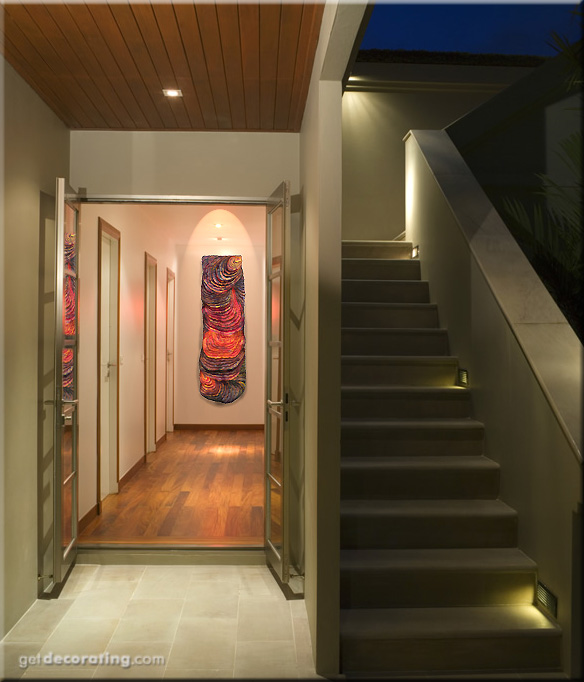
When I saw this image of a doorway/stairway I thought it would be the perfect place for Pele, the silk carving. The original painting that hangs on this place of the wall is surely an eyecatcher with its vibrant colours (see below) but I am sure the designer would have chosen the dramatic silk piece if s/he had known about it - not? What would be your choice?


original image source from http://www.getdecorating.com

The silk sculpture was inspired by the Hawaiian legends of Pele, the Hawaiian Akua (Goddess), the fire goddess, mother of all life which comes out of the depth of the earth. 
In Hawaiian mythology women were a powerful source of new life and source of spiritual power. In the Polynesian world Mana Wahine - the power of woman - was a force that must never be ignored. It was Hina (Woman) who gave birth to new life, Hina controlled the moon, the tides and the reefs and Hina had the secret of fire.

Pele incorporates a technique called silk carving©, which is a development by the artist. The intent of this technique was to create a symbiosis between carving and fiber art. The surface of the fiber was transformed completely into a relief. The upper layer of this piece was made from one single piece of silk - nothing was sewn on top to add depth. Additionally paints and pigments were used in a manner to give the visual impression of flowing lava in all its glowing colours and the viewer is supposed to feel the heat. But it is "only" a piece of soft sculptured silk.

 "Pele"
( from the Hawaiian Symbols series)
silk carving, 48" x 17"
©Petra Voegtle

If you would like to see more detail photos please check this link

Btw - this art piece was shown at several art venues in the USA and was featured by art critic Cate McQuaid in the Boston Globe.

Wednesday, April 14, 2010

Lost Treasures in the Hallway

The hallway of this house looks marvellous with its space for arts and crafts. So my thought for this stairway was - if it were mine - to hang this silk carving with its trees and floral environmental theme: Lost Treasures as a complementary art piece to the wonderful pottery besides the stairways.

As I already said - the silk carving is an environmental piece and - belonging to the Hawaiian Symbols series - it stands for all the extinguished flora and fauna of this world. Especially the Hawaiian archipelago has lost many of its endemic species thanks to the introduction of too many aliens due to the ignorance of immigrants and natives - mostly not with bad intentions but nevertheless deadly for the existing species.

 original image source from http://www.getdecorating.com


"Lost Treasures"
( from the Hawaiian Symbols series)
silk carving, 66" x 17"
©Petra Voegtle

If you would like to see more detail photos please check this link
~
Related Posts Plugin for WordPress, Blogger...